Make me sound smart
I was in a Zoom meeting today, using the My Notes transcription feature. It’s super useful now that I can go back over a meeting with an LLM. Normally it just starts automatically and I leave it alone, but this time I clicked on it by accident, and it opened a window with three shortcuts. One of them said “Make me sound smart”.
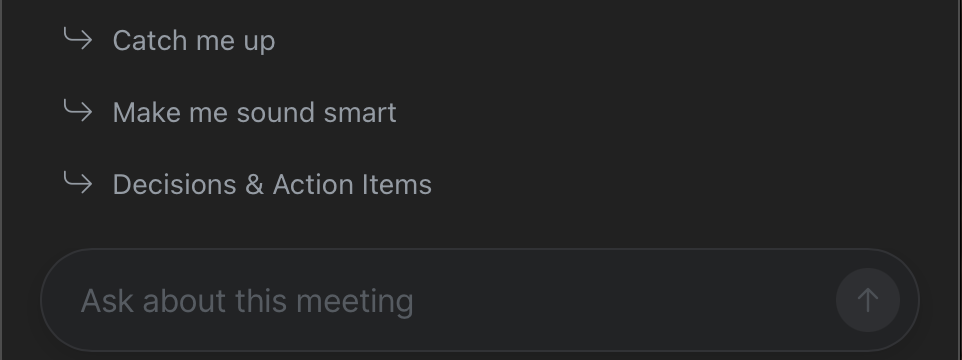
The boasting button
The other two make sense. “Catch me up” helps if you join late or lose the thread, and “Decisions & Action Items” saves you writing them down. Both have a clear use: they help you follow the meeting.
“Make me sound smart” is at odds with them. It doesn’t help you follow anything. It’s a boasting button, and if I were the product manager, I wouldn’t have put it there.
What does it get you?
Imagine clicking it. It suggests a comment, you say it, and for a moment you sound smart. Then someone asks, “What do you mean by that?” Where do you go then? Ask AI Companion for help? The comment only holds up as long as nobody asks about it. It’s a trust trap.
What really grates with me is the word “sound”. I’m sure the button is well intentioned, but there’s a hollowness to it: sounding smart rather than being smart.
Instead, I’d have used a different call to action: “Explain what they just said” or “Suggest a question”. Both would help you understand the discussion better.
Don’t be a meat proxy
You may well have heard the term by now. A meat proxy is someone who passes on what an LLM says without adding anything of their own. It spread after Niklas Gruhn’s essay in August, and Thoughtworks has put it on its latest Technology Radar under “Caution”. “Make me sound smart” is a button for being one, live, in front of your colleagues.
Used well, LLMs can make you much better at what you do. Used like this, they can have the opposite effect.
Feed my mind, not my ego.
Further reading
- Niklas Gruhn, Don’t be a meat proxy, gruhn.me, August 2026. The short essay that gave the habit a name, and a plain case for reading what the AI says and replying in your own words.
- Thoughtworks, Meat proxy, Technology Radar Vol. 35, November 2026. Why passing on unread AI output isn’t harmless: it hands the checking to whoever receives it.